
If you like dramatic weather photography you’ll enjoy this time-lapse film on YouTube by Mark Oblinski, a storm chasing photographer. And this one is beautifully timed to the music.
.
In this post we’re going to discuss lens focal length and related topics.
There is a bunch of technical specifications and math involved in what focal length actually measures. It has to do how light is bent by a lens and the distance from the plane of the film or sensor to the point of infinity focus. Or something like that. Thankfully we don’t need to actually understand the physics in order to know how focal length applies to photography in practical ways.
Focal length is measured in millimeters, and what you do need to understand is what the numbers mean in general terms. A short focal length (low number) provides a wide-angle of view. A long focal length (high number) provides magnification and a narrow angle of view.
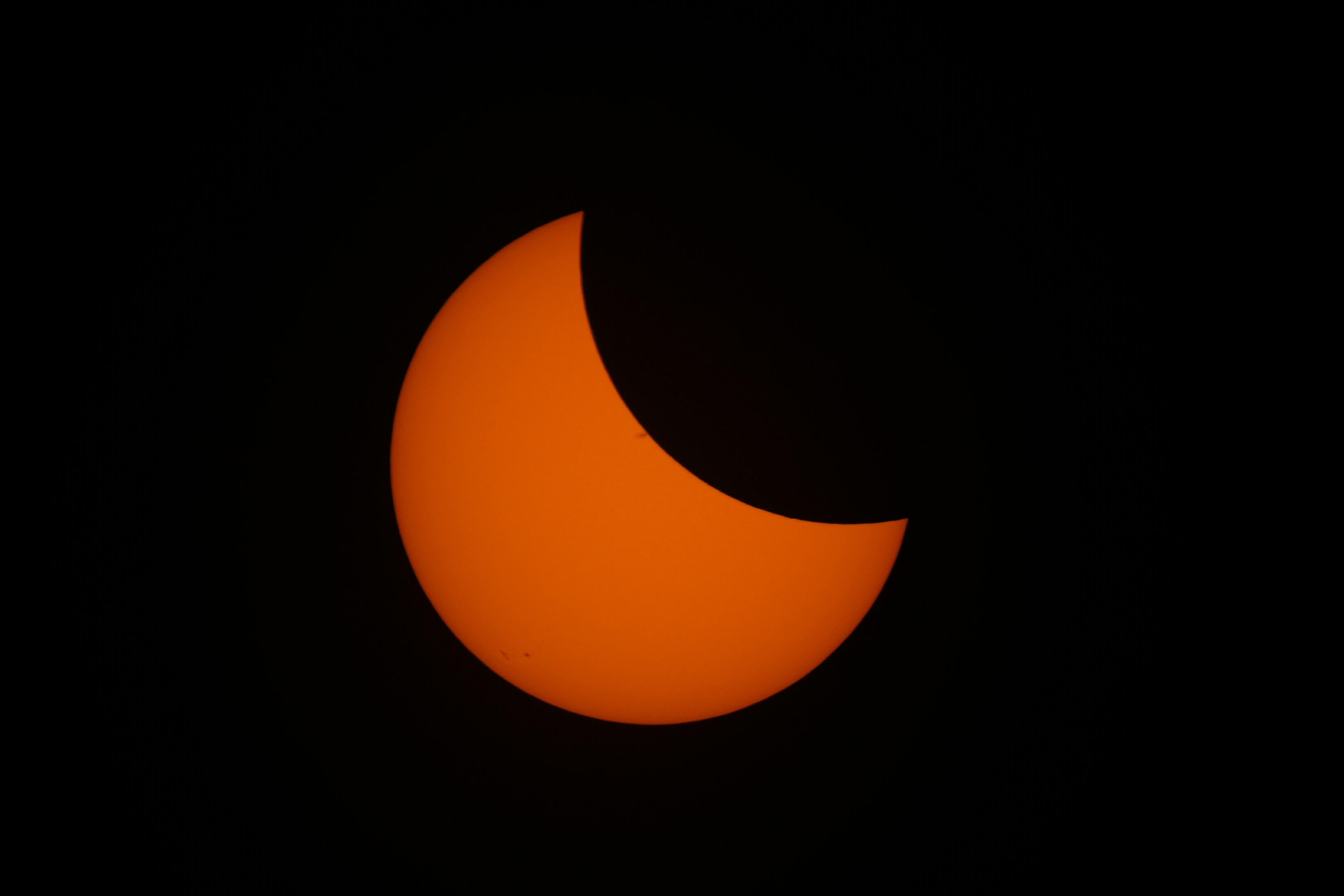
The last time I had a chance to see a solar eclipse was in 1979. It was 98% coverage where I lived in Edmonds, if I’m recalling correctly. But, typical of Western Washington, we had thick cloud cover on that February day. It was so disappointing. The year 2017 for the next eclipse was impossible to even comprehend for my 17 year-old self.
But here I am, a middle-aged woman in the year 2017. Amazing. The whole thing is still kinda weird if you ask me.
When this eclipse started drawing near I was hesitantly excited because I so much wanted to see it but was dreading another huge disappointment. I figured this would be my last chance to see an eclipse in this lifetime.
The weather gods took pity on me. We didn’t have the typical morning marine layer as the day dawned, only horizon haze, with no clouds to speak of overhead.
 Park Preview